
Caledonia Previous Resident Sources
A sound address history uses sources from several eras. Racine County land records establish a property chain, while a directory or census can place a household near the same address on a certain date. The sources do not form one complete series. Caledonia had rural parcels, changing postal labels, and old community names, so gaps are normal. The era table helps choose a first stop without claiming broader coverage than the collections provide.
| Source | Dated coverage | Custodian or collection | Best evidence |
|---|---|---|---|
| LandShark and recorded deeds | Modern tract and images from 1989; county says documents reach the early 1900s online | Racine County Register of Deeds | Recorded parties, transfer date, and legal description |
| Racine directories | Selected years from 1850 through 2006, with gaps | Racine Public Library and UW-Parkside | Dated name, address, trade, or business lead |
| Farm directories | 1897-98, 1919, 1934, and 1947 examples | UW-Parkside and Wisconsin Historical Society | Rural farmers, businesses, and property context |
| Federal census | Public releases governed by the 72-year rule | Library genealogy databases and federal sources | Household members at an enumeration date |
| Vital and newspaper records | Varies by record type and repository | Wisconsin DHS, county offices, and library microfilm | Events, relationships, notices, and obituaries |
For recent Caledonia previous residents, begin with the current parcel and work back through deeds. For a nineteenth-century farm or a road without a house number, try farmer directories, census schedules, newspapers, plats, and cemetery clues first. A missing directory entry may only mean that the volume skipped a year or did not cover rural Caledonia.
Walk Caledonia Deeds Backward
The Racine County Tax Inquiry can supply the current parcel ID, site address, owner field, sales history, and links into the county land systems. Record that parcel ID before using the Register of Deeds routes. Street numbers can change, but a parcel identifier and legal description make it easier to follow the land. County staff provide public computers during the listed search window, first-come and first-served. They do not conduct a document search for the requester, so bring names, dates, and parcel details.
- Find the current parcel through Tax Inquiry, Ascent, or the village assessor link. Save the parcel ID, site address, and legal-description summary.
- Locate the present owner's acquisition deed in LandShark or the newer TriMin Document Search. Note the seller, recording date, and document number.
- Search that seller as a grantee, the buyer in an earlier transfer. Confirm that the legal description matches before accepting the result.
- Repeat the seller-to-buyer handoff for each prior deed. Keep uncertain matches separate instead of forcing a continuous chain.
- When online indexing no longer answers the question, use the courthouse public computer, genealogy appointment, older books, or microfilm route.
LandShark guidance describes tract indexing and images from 1989 forward, while the county also says documents back to the early 1900s are online. Those statements are not identical guarantees for every parcel. Check the actual index and image status. Email, mail, and counter copy requests remain useful once a recording number is known.
- Grantor and grantee
- The grantor transfers an interest; the grantee receives it.
- Chain of title
- The dated sequence of recorded transfers affecting the same land.
- Legal description
- The formal land description in a deed or survey, often more durable than a street address.
- Parcel ID
- The county's identifier for a tax parcel, useful for moving between tax, map, and deed systems.
Caledonia Record Milestones
Caledonia address research crosses paper and digital eras. Racine County began accepting fully electronic documents in 2003, but that milestone does not mean all older records became searchable in one format. The county's modern LandShark material describes 1989-forward tract indexing and images, while older documents use different index paths. A careful search records both the document date and the way it was accessed.
| Date or span | Why it matters to previous residents |
|---|---|
| 1839 | Racine County marriage registration begins, though survival and filing vary. |
| 1850 and 1858 | Early Racine directory examples begin the regional printed-directory trail. |
| 1877 and 1880 | County birth and death registration beginnings add event records. |
| 1989 forward | Modern LandShark tract indexing and image coverage is documented. |
| 2003 | Racine County's fully electronic document acceptance begins. |
| 2006 | The UW-Parkside Racine directory inventory reaches its latest listed annual volume. |
No official source reviewed documented a Caledonia-wide street-renumbering year or a destroyed county record group. Do not repair a gap with a guessed date. Use dated deeds, plats, directory wording, and maps to explain any change.
Caledonia Leads in Racine Directories
The UW-Parkside directory inventory lists Racine volumes for 1850, 1858, 1876, many late nineteenth-century years, alternating runs in the early twentieth century, and mostly annual runs from 1957 through 2006. These are Racine directories, not a verified complete Caledonia series. A rural family may be absent even when a volume survives.
Farm directories can be stronger evidence for outlying land. Smith's 1897-98 Racine and Kenosha directory, the 1919 Prairie Farmer volume, the 1934 Home and Farm directory, and a 1947 farm directory are documented leads. Search a surname, first initial, road, farm, business, township, and nearby year. Preserve the publication's exact place label rather than silently replacing it with modern Caledonia.
Address-first, or criss-cross, directories can show an occupant when the surname is unknown. No exact Caledonia-specific reverse-directory run was found. The full regional shelf and its publication gaps are described on the Caledonia city directory page; here, each volume serves only as one dated step in the backward address trail.
Note: A directory entry is a lead for one publication date, not proof of ownership or a complete household.
Match Caledonia Households by Date
Ownership and occupancy are separate questions. A deed records a transaction. A census is a federal enumeration snapshot, while a directory prints what its publisher gathered for a certain edition. Pairing them can show who lived here before, including people who never appeared as deed holders, but the names and dates must align.
- Transcribe the address exactly from the deed, directory, newspaper, or census. Keep a rural route or hamlet label intact.
- Check the nearest available directory before and after a public census year. Record gaps rather than treating them as absence.
- Compare household names, ages, relationships, road order, and nearby households in the census image.
- Test the location against a dated plat, parcel record, or legal description. Label any modern location as an interpretation.
- Confirm the person through an obituary, cemetery record, vital index, newspaper notice, or another independent source.
The Racine Public Library genealogy and local-history collection connects researchers with directories, census tools, newspapers, cemetery material, FamilySearch, HeritageQuest, BadgerLink, and onsite Ancestry Library Edition. The History Room requires an appointment, and staff locate material because browsing is limited.
The library access page pictured below shows the practical doorway into those Caledonia historical sources.

Its mix of onsite, card-based, and open web resources explains why no single online search can replace the full household workflow.
Caledonia Names Before Modern Addresses
Older residents may appear under Tabor, Linwood, Ives Station, Skunk Grove, Franksville, Husher, Sterns Crossing, Lamberton, Willow Creek, Thompsonville, or North Racine. The official Village History ties some names to present roads and landmarks. Tabor, for example, grew from Bohemian settlement and remains linked to Douglas Avenue and Tabor Road. North Racine is now associated with the City of Racine, so it cannot be treated as a simple synonym for today's village.
The spelling trail matters too. Village history preserves a Husher and Hoosier name story. Search both forms when a directory, newspaper, or cemetery source uses one. Around Ives Station, railroad and stone-crushing history may explain why a person or business appears under a station or worksite label instead of a numbered street.
Keep an old place name as written, then add a modern interpretation only after checking a deed, map, newspaper, or historical source. This small discipline prevents a regional Racine listing from being turned into unsupported proof that a person lived within current Caledonia boundaries.
Caledonia Previous Residents in Archives
The Wisconsin Historical Society's Caledonia-filtered search showed 37 items dated to the 1800s, 53 from the 1900s, and four from 2000 or later when reviewed. Category counts included Architecture and History Inventory records, images, and register records. Those counts describe catalog results, not a name index of previous residents.
The filtered collection screen offers another route when an address is tied to a building, landmark, photograph, or local place.
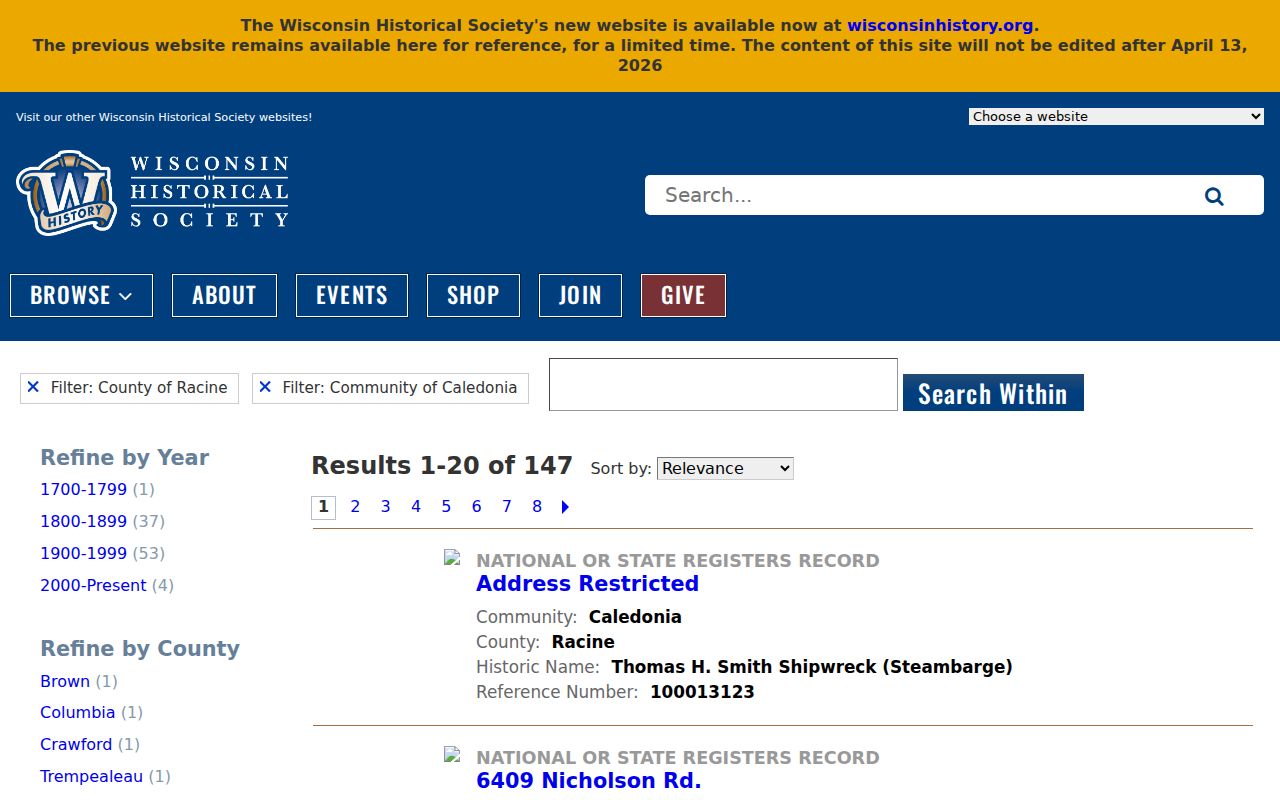
Open each item and retain its title, date, creator, place, identifier, and access note before connecting it to a household.
The Caledonia Historical Society offers a physical local route at its historical village on Five Mile Road. The grounds include the 1877 Town Hall, and seasonal open houses are held on the third Sunday from May through October. Ask volunteers about maps, photographs, schools, churches, cemeteries, and family files by a specific name and date range. No standard research fee or complete public holdings catalog was found, so confirm access before a visit.
Close Caledonia Trails with Events
Newspapers can connect a former address to relatives, a church, a cemetery, or another settlement. Racine Public Library provides newspaper microfilm, while Chronicling America covers historic newspaper pages from 1777 through 1963. Search the full name with variant spellings, spouse or parent names, Tabor or another hamlet, a cemetery, and a narrow date range. Record the paper title, page, and date.
No separate complete Caledonia obituary index was found. An obituary is also a family or community account, not the same evidence as a certificate. Wisconsin vital records add official event evidence when access rules permit. The county's earliest registration baselines are 1839 for marriages, 1877 for births, and 1880 for deaths, but a baseline does not promise that every event survives.
For probate or a divorce decree, use the Racine County Clerk of Circuit Court rather than a general vital search. For older vital indexes, check Wisconsin Historical Society resources before applying for a copy. Record a no-result outcome as a search result, not proof that the person or event never existed.
Rate Each Caledonia Resident Match
A useful previous-resident record keeps the source claims apart. Save the person's name, the date and place, the source title, the address exactly as printed, the modern jurisdiction interpretation, and any unresolved identity. A deed supports recorded parties. A directory supports a dated listing. A census supports an enumeration, and an obituary reports relationships and events.
- High confidence: the address, date, and identity agree across two independent sources.
- Moderate confidence: one strong source matches, but a date, spelling, or boundary question remains.
- Low confidence: only a surname, broad Racine label, or nearby property connects the person.
- Unresolved: competing people or locations cannot yet be separated.
This method preserves doubt instead of hiding it. It is especially important for common surnames and regional directory entries that do not state whether the property fell inside modern Caledonia.
Use Caledonia History Lawfully
Research on past residents fits family history, estate work, local history, and curiosity about an old home. It does not justify tracking a living person or trying to defeat an address-confidentiality measure. Wisconsin public records can also be withheld or redacted under statutes, specific confidentiality rules, and the custodian's balancing test.
Lawful use. Respect protected addresses and living people; Wisconsin stalking and harassment laws include Wis. Stat. §§ 940.32 and 947.013.
If a source is closed, use the stated request or appointment process. Do not infer the missing fact. The strongest account of Caledonia previous residents is dated, sourced, limited to what each record proves, and clear about every gap.