
Caledonia Historical Collections
No verified publication is a complete, Caledonia-only city directory. The available shelf is regional. Racine city volumes, farm directories, library databases, and archive catalogs each cover different people and years. Check a title page before assuming the word “Racine” means City of Racine only or that rural Caledonia homes were included.
| Collection | Years | Where Held | Access |
|---|---|---|---|
| Racine city directories | 1850 through 2006, with many gaps and changing cadence | Racine Public Library; UW-Parkside inventory | Reference shelf, archive inquiry, year browse |
| Smith's business and farmers directory | 1897 and 1897–98 references | Wisconsin Historical Society; catalog and reel clues | Online catalog/text record; repository follow-up |
| Prairie Farmer directory | 1919 | UW-Parkside archive inventory | Archive access inquiry |
| Home and Farm directory | 1934 | UW-Parkside archive inventory | Archive access inquiry |
| Kenosha farm directory | 1947 | UW-Parkside archive inventory | Archive access inquiry |
Racine Public Library describes its directory run as reaching back to 1858. UW-Parkside also lists an 1850 volume and supplies the detailed year inventory. Publishers vary by volume, and the books were privately issued rather than official rolls. No exact Caledonia reverse or criss-cross run was found. A missing person can therefore reflect scope or a missing publication year, not an absence from the area.
Why Caledonia Uses Village Records
Official sources call Caledonia the Village of Caledonia, not a city. The municipality moved from town to village status around 2005–2006; two official pages give different years, so the transition should be described as a range. Earlier records may use Caledonia Town, Racine, Franksville, North Racine, or a local settlement name. A good city directory search preserves that original label.
Village Hall at 5043 Chester Lane is the current hub for general municipal records. The Village Clerk routes non-police requests, licenses, elections, agendas, minutes, Board of Review, tax levy, and public notices. Police, Municipal Court, land records, and state databases have separate custodians. The municipal directory is a routing list, not a master list of residents.
Village Clerk
General records, notices, elections, permits and licenses. Email requests can go to jbass@caledonia-wi.gov.
Village Police
Accident, incident, call, photo, and body-camera requests at 5045 Chester Lane, subject to legal limits.
Municipal Court
Local traffic and ordinance matters. Circuit cases belong to the county clerk and WCCA.
Land Offices
The Assessor handles assessment data; county GIS, Real Property Listing, and Register of Deeds handle other parcel records.
Caledonia City Research at Racine Library
Racine Public Library genealogy and local history is the main physical shelf for regional directory work. The directories are reference-only under call number 917.75 R11. The main library is at 75 7th Street in Racine, and the published general hours are Monday through Thursday 9 a.m. to 8 p.m. and Friday through Saturday 10 a.m. to 4 p.m.
The History Room requires an appointment. Rebecca Leannah is the listed contact at 262-636-9255 and Rebecca.Leannah@RacineLibrary.info. Staff can locate materials, but browsing is limited. Ancestry Library Edition requires on-site use. BadgerLink may require a library card. HeritageQuest includes censuses, books, cemetery records, directories, military records, and family histories. Newspaper microfilm and Chronicling America add obituary, notice, and settlement-name searches.
The library's collection page shows the access choices that supplement the city directory shelf.

That mix of in-person and online sources is important because no complete Caledonia-only directory has been identified.
Note: Ask for a year, surname, road, or collection title; staff cannot promise an unbounded search for every record on a family.
Read a Caledonia Historical Entry
No actual named entry was retained during research, so none should be invented. Instead, record the fields from the chosen page exactly as printed. Begin with the volume title, publisher, year, page, and geographic heading. Then transcribe the person or business line. Photograph or copy the abbreviation key because short marks can change meaning between publishers.
| Volume and year | Identifies the dated edition and prevents entries from different years being merged. |
|---|---|
| Original name | Preserve initials, spelling, spouse or widow notation only when printed. |
| Occupation or business | Record the exact role and any business address as a period clue. |
| Street or place | Keep house number, road, farm, township, hamlet, and postal wording unchanged. |
| Owner or renter mark | Use only when the volume prints one and its key defines the symbol. |
| Repository and URL | Capture call number, page image, index link, or archive identifier. |
- Criss-cross directory
- An address-first section arranged by street rather than surname. A Caledonia-specific run was not verified.
- Householder index
- A list focused on the person shown as the primary household listing, not necessarily every resident.
- Abbreviation key
- The publisher's legend for shortened words and symbols. Its meanings control how an entry should be read.
Do not assume every edition lists a spouse, occupation, owner mark, or full address. The city directories were private publications with changing formats and scope. A printed entry is evidence that the publisher associated that line with that place in that edition.
Caledonia Publication Years Have Gaps
The UW-Parkside directory inventory lists Racine editions for 1850, 1858, 1876, annual years from 1882 through 1885, 1887–1888, 1890–91, 1894–95, a partial 1897 edition, 1899, 1901–02, 1902, 1904, and 1906. It then lists even years from 1912 through 1920, odd years from 1921 through 1945, selected 1950s years, annual volumes from 1957 through 2001, and annual volumes from 2003 through 2006.
| Period | Verified directory pattern |
|---|---|
| 1850–1906 | Scattered editions with several close runs and a partial 1897 volume |
| 1912–1920 | Every even year in the inventory |
| 1921–1945 | Every odd year in the inventory |
| 1950–1955 | 1950, 1952, 1954, and 1955 |
| 1957–2006 | Annual 1957–2001 and 2003–2006 |
A skipped year should remain a gap in the evidence. The inventory does not establish that the publisher stopped, that every listed book includes Caledonia, or that 2006 was the last Caledonia-specific volume. Search the nearest available years and label the interval.
Farm Directories Reach Rural Caledonia
A standard Racine city directory may miss a Caledonia farm or township household. Farm and business volumes can be better leads. Smith's 1897 directory covered Racine and Kenosha businesses, farmers, and property valuations in 192 pages. UW-Parkside also identifies a 1919 Prairie Farmer directory, a 1934 Home and Farm directory, and a 1947 Kenosha farm directory.
The Wisconsin Historical Society Smith's directory record provides catalog and reel clues. Search by surname, first initial, road, township, crop, trade, or business. Official Caledonia history mentions wheat, grains, strawberries, cabbage, sugar beets, cattle, milk, stone crushing, railroad work, pickle activity, and sauerkraut. Use those terms only within a dated historical search.
Farm-directory property values and business labels are period statements. They do not establish current ownership or operation. Compare a promising line with a census, deed, newspaper, plat, or vital record.
Caledonia's Current Municipal Directory
Current village departments help interpret recent records that will not appear in a historical volume. Planning and Zoning keeps site plans, subdivision and condominium plats, rezonings, conditional uses, variances, compliance files, maps, and development records. The department took over local planning, zoning, and code enforcement from Racine County in May 2019. Earlier files may remain with the county.
Building and Inspection has used Wisconsin's online new-home permit process since November 19, 2019, followed by village submittals. Engineering covers public works, permits, traffic, wetlands, floodplains, and projects. The Assessor's contracted service publishes assessment data while excluding telephone and Social Security numbers from the assessment file.
Boards, commissions, agendas, and notices may name an official, applicant, owner, representative, or witness. Preserve that role and date. Neither a public meeting appearance nor a permit line is proof that someone lives at the stated place. The same rule applies to village licenses and to public organization pages.
Caledonia Records in State Collections
The Wisconsin Historical Society Caledonia filter offers another collection route. On the research date, it showed items across 1800s, 1900s, and 2000-plus date bands, including Architecture and History Inventory records, historical images, and register material. Counts belong to that dated interface and can change.
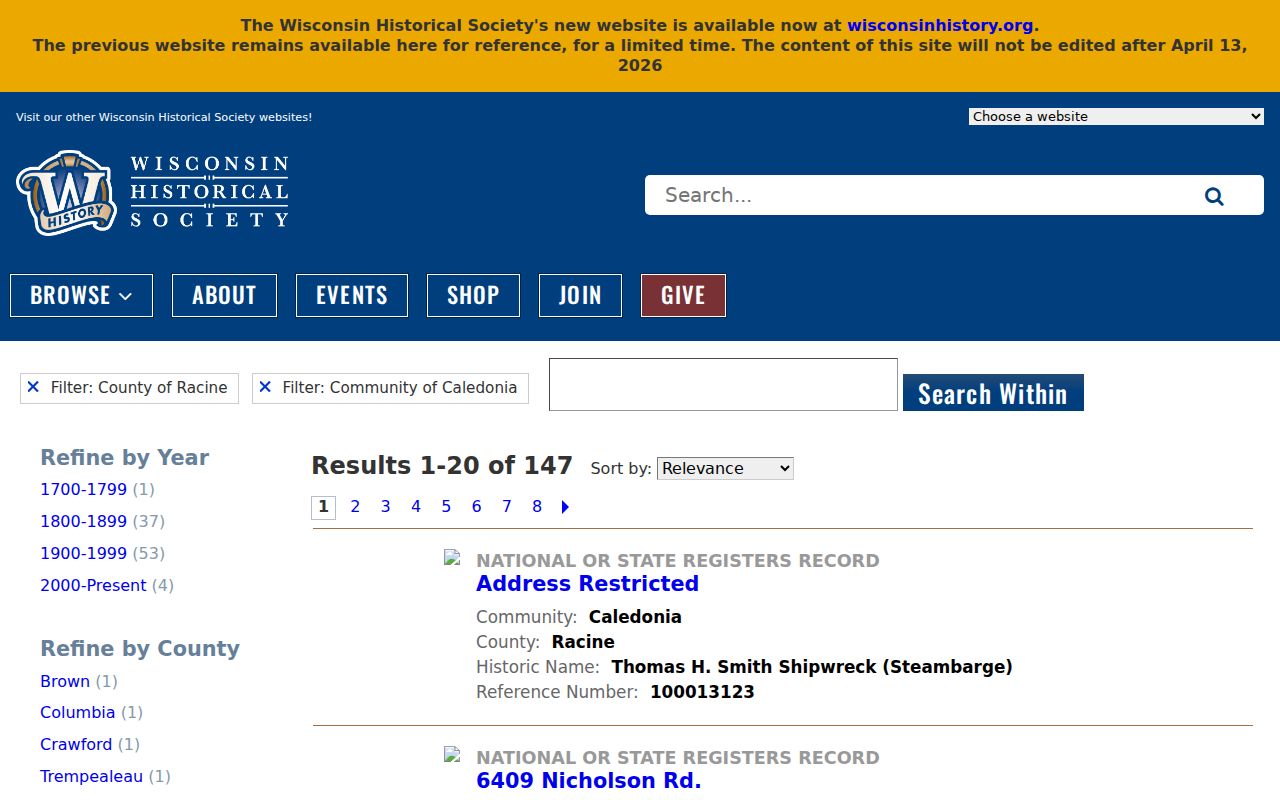
Open each catalog record and save its title, creator, date, place, item identifier, and access statement before using it as evidence.
The Caledonia Historical Society adds the 1877 Town Hall, school, cemetery, maps, photographs, and local-history leads at its historical village. It does not publish a complete resident roster. State archives can also lead to naturalization, military, newspaper, and family-history material, but no Caledonia-specific all-name index was found.
Caledonia Directory Timeline Markers
Several firm dates help place a name in the right system. They describe access milestones, not complete digital coverage.
- 1850 and 1858: the earliest Racine directory examples in the archive inventory and library description.
- 1897: Smith's business and farmers volume gives a regional rural alternative.
- 1999: Wisconsin Circuit Court Access begins its online era; older case files may remain on paper or microfilm.
- 2003: Racine County begins fully electronic document acceptance, while older land indexing follows different patterns.
- 2005–2006: Caledonia moves from town to village status, with an official-source discrepancy on the exact year.
- 2019: village planning and zoning custody changes, and the state online building-permit route begins for new homes.
A record before the village transition may be filed under town or county systems. Date the search before choosing a custodian.
Trace Families in Caledonia Records
Family history works best when a city directory entry is treated as one dated layer. Start with a full name and known year. Search initials and spelling variants, then repeat the search under Racine, Caledonia Township, Franksville, and the documented hamlet name. Bohemian surnames and the Husher or Hoosier wording are notable local variant clues.
- Find the earliest likely directory line and save the volume, year, page, publisher, name, and address exactly as printed.
- Check the next available edition. Note a move, spelling change, business, spouse, widow notation, or gap without guessing what caused it.
- Search an address-first section if the volume has one. Since no Caledonia-specific criss-cross run is verified, ask the library before assuming access.
- Pair the directory with the closest released federal census under the 72-year rule. Keep the directory date and census date separate.
- Test the relationship with deeds, county vital records, newspaper microfilm, cemetery sources, or a historical-society item.
Disappearance from an edition can mean a move, death, omission, publication gap, unlisted household, or an address outside the volume's scope. Search nearby years and family names before selecting one explanation. Vital records have eligibility and ID rules; Racine newspaper research has no separately named complete obituary index. The library's microfilm and historical newspaper databases are the documented route.
If a historical address must be compared with the current parcel, use the Caledonia street directory workflow. Keep the property chain separate from the people chain: a deed records a transaction, a directory records a published listing, and a census records an enumeration.